You can't ship AI you can't evaluate
AI features are non-deterministic, so 'it looked right in the demo' isn't a test. Evals - a dataset plus graders, run in CI and prod - are how you ship them.
5 min read
The thing that separates an AI feature you can actually ship from a demo that impresses in a meeting is an eval - a repeatable way to measure whether the output is good. Because the model is non-deterministic, "it worked when I tried it" isn't a test, and without evals you're shipping on vibes. An eval is simply the test suite for a probabilistic system: a dataset of real cases plus graders that score each output, run automatically on every change and monitored in production. Teams that have this iterate with confidence and catch regressions before users do. Teams that don't discover their AI quietly got worse from a support ticket. This isn't optional infrastructure anymore; it's the difference between an AI feature and an AI liability.
Why this matters now
As AI features move from prototype to production, the teams that succeed are the ones treating evaluation as core infrastructure, not an afterthought. Gartner projects that LLM observability and evaluation investment will reach 50% of GenAI deployments by 2028, up from about 15% today - a signal that evals are becoming standard practice rather than a specialist luxury. The reason is simple: you cannot improve, or safely change, a system whose quality you don't measure.
The trap is that AI features demo extremely well. A model produces a great answer to the three inputs you tried, everyone nods, and it ships. Then real users send the thousand inputs you didn't try, the model handles some of them badly, and - because there's no eval - nobody notices until it's a complaint. The demo measured nothing; it just got lucky on a small sample.
What an eval actually is
An eval has two parts, and neither is exotic.
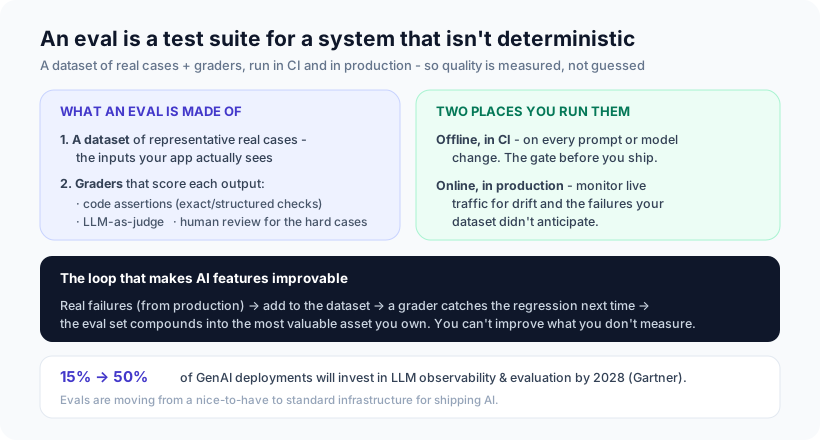
1. A dataset of representative cases. The inputs your application actually sees - not three cherry-picked examples, but a growing set that covers the real distribution, including the edge cases and the failures. This dataset is the single most valuable asset in an AI product, and it compounds: every real-world failure you add makes the next release safer.
2. Graders that score each output. There are three kinds, used together:
- Code assertions - deterministic checks for anything you can verify programmatically: valid JSON, the right fields present, a number in range, no forbidden content. Cheap, fast, exact. Use these wherever possible.
- LLM-as-judge - a separate model scoring subjective qualities (is this summary faithful? is the tone right?) against a rubric. Powerful for the fuzzy stuff, but it has its own biases, so you calibrate it against human judgments rather than trusting it blindly.
- Human review - for the genuinely hard or high-stakes cases, and to keep the automated graders honest.
The mechanism: offline gate, online monitor
Evals earn their keep in two places, and you need both (Anthropic's guide to evals for agents walks through the same split):
- Offline, in CI. Run the eval suite on every prompt tweak and every model change. This is the gate - the thing that tells you a "small" prompt edit quietly broke 15% of your cases before it ships. It's what lets you upgrade models without crossing your fingers.
- Online, in production. Monitor real traffic for drift and for the failures your dataset didn't anticipate. Production is where you discover the inputs you never imagined - and those failures feed straight back into the dataset.
The dataset is the product. Every real failure you capture and add is a regression a grader will catch forever after. An AI feature without an eval set isn't finished - it's just untested code that happens to look right today.
Our opinion
Our take: write the eval before you polish the feature. The instinct is to make the demo dazzling and add measurement "later," but later is exactly when a model change silently degrades quality with nobody watching. Starting with even a tiny eval - twenty real cases and a few code assertions - changes how you build: every prompt change becomes a measured experiment instead of a hopeful guess, and you can actually tell whether you're making things better.
We'd also argue against over-tooling this early. You don't need a platform to start; you need a spreadsheet of real inputs, expected-quality notes, and a script that runs them. The discipline matters more than the tooling. This is the same reliability-first instinct behind everything we build - and it's the practical counterweight to the hidden cost of unreviewed AI code: you keep the speed of AI only if you can measure what it's doing.
How Ashvara helps
We build AI features with evals from day one: a dataset of your real cases, the right mix of code, LLM-judge, and human graders, wired into CI so every change is measured, plus production monitoring so drift surfaces as a dashboard rather than a complaint. The result is an AI feature you can actually change and improve with confidence - not one you're afraid to touch.
If you're shipping something AI-powered and want it built so quality is measured rather than hoped for, that's our AI solutions work. Talk to us and we'll help you ship AI you can stand behind.
Source: Anthropic - Demystifying evals for AI agents; Gartner projection that LLM observability reaches 50% of GenAI deployments by 2028 (from ~15% today).