Fine-tune, RAG, or prompt? Reach for them in this order
Prompting changes instructions, RAG changes knowledge, fine-tuning changes behavior. Prompt first, add RAG for your data, fine-tune only when both fall short.
6 min read
Prompting, RAG, and fine-tuning aren't competing choices - they're three different levers, and the right move is to reach for them in order: prompt first, add RAG when the model needs your data, and fine-tune only when both provably fall short. They change different things. Prompt engineering changes the instructions you give the model. RAG (retrieval-augmented generation) changes the knowledge the model can see by feeding it your documents at answer time. Fine-tuning changes the behavior of the model itself by continuing its training. Confusing them - or jumping straight to the expensive one - is how teams spend months and six-figure budgets fine-tuning a problem that a better prompt would have solved. The order matters because each step multiplies cost and complexity.
Why this matters now
The economics shifted hard in favor of starting simple. Today's frontier base models are good enough that prompt engineering alone handles 60-70% of production use cases that teams were fine-tuning for just 18 months ago. The default that made sense in 2024 - "fine-tune a model on our data" - is now the wrong first move for most problems. Meanwhile the cost gap between the three approaches is enormous: prompting is hours to days and effectively free, RAG is days to weeks and roughly $70-1,000/month, and fine-tuning is weeks to months plus around 6x the inference cost.
Reaching for the expensive lever first isn't ambitious; it's a way to pay 6x for something the cheap lever would have done.
Three levers, three things they change
The clearest way to choose is to know exactly what each one moves.
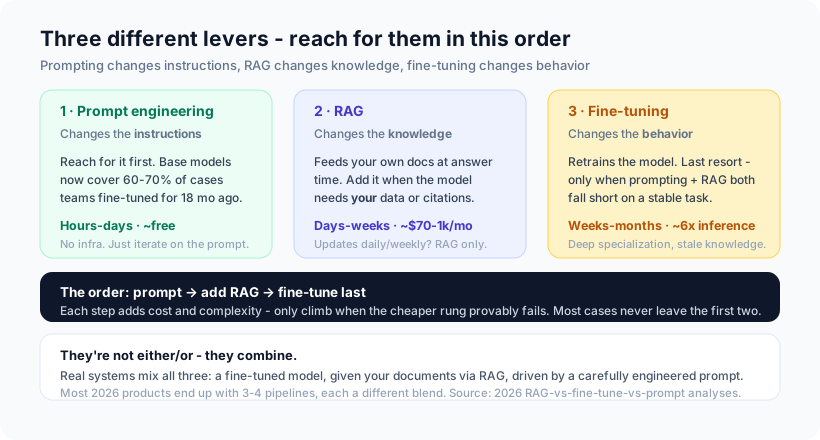
- Prompt engineering - changes the instructions. The first move, always. It's free, instant to iterate, and with modern base models it's enough for the majority of tasks. If you haven't seriously engineered the prompt, you haven't earned the right to reach for anything heavier.
- RAG - changes the knowledge. When the model needs information it wasn't trained on - your product docs, your policies, your customer data - RAG retrieves the relevant pieces and puts them in the prompt at answer time. It's the answer for private data, for anything that changes frequently, and for anything that needs source attribution (citations are structurally a RAG feature).
- Fine-tuning - changes the behavior. Continuing the model's training to bake in a style, format, or specialized skill. It's powerful for deep specialization on a stable task, but it's the slowest and most expensive, and it doesn't help with fresh knowledge - a fine-tuned model still has a training cutoff.
The decision, made simple
A few rules of thumb cut through most of it:
- Knowledge changes daily or weekly? RAG, full stop - you can't fine-tune fast enough to keep up, and prompting can't hold it all.
- Need citations or source attribution? RAG - it's the only approach that can point at where an answer came from.
- Need a consistent format or behavior at very high volume, on a task that doesn't change? Now fine-tuning may earn its cost.
- Everything else? Start with prompting and be surprised how far it goes.
The order isn't a preference, it's an economic gradient. Each rung up costs more and moves slower, so you only climb when you can prove the rung below it failed. The most expensive mistake in applied AI is fine-tuning a problem that prompting would have solved.
They combine - it's not either/or
The framing as a competition is misleading. Real systems mix all three: a fine-tuned model, given your documents via RAG, driven by a carefully engineered prompt. Most production AI in 2026 ends up as three or four pipelines, each a different blend for a different job, with an orchestration layer choosing between them. The skill isn't picking one religion; it's knowing which lever each specific problem actually needs - and not paying for the ones it doesn't.
Our opinion
Our take: default to prompting, reach for RAG the moment private or fresh data enters the picture, and treat fine-tuning as a deliberate, evidence-backed decision - not a starting point. The pattern we see over and over is a team that decided "we need to fine-tune" before they'd written a serious prompt or tried retrieval, and burned a quarter proving that the base model was already fine. The base models got good; the right architecture got cheaper and simpler at the same time.
We'd also stress that whichever levers you pull, you can't tell if you've improved anything without measuring it. The reason "start simple" works isn't faith - it's that you evaluate each step and only escalate when the numbers say the cheaper approach hit a wall. This is the same measure-first, right-size-the-tool instinct behind not defaulting to a frontier model: build what the problem needs, proven with evidence.
How Ashvara helps
We build AI features and we start on the cheap rung: a well-engineered prompt, evaluated honestly, then RAG when your data demands it, and fine-tuning only when the evidence justifies the cost. You get an AI system architected for what your problem actually needs - not an expensive fine-tune that a prompt would have beaten, and not a fragile prompt where you genuinely needed retrieval.
If you're deciding how to build an AI feature and want it architected on evidence rather than habit, that's our AI solutions work. Talk to us and we'll help you pull the right lever first.
Source: 2026 comparative analyses of RAG vs fine-tuning vs prompt engineering (base models now cover ~60-70% of former fine-tuning cases; cost gradient from ~free prompting to ~6x-inference fine-tuning; start-with-prompting decision framework) - see RAG vs Fine-tuning vs Prompt Engineering (InterSystems).