AI-native vs AI-as-a-feature: which are you building?
Remove the AI - does your product still work? If yes it's a feature; if the business collapses it's AI-native. That gap decides defensibility, not the model.
6 min read
There's a one-question test that tells you whether you're building an AI-native product or just adding an AI feature: remove the AI, and does the product still work? If it does, you're AI-enabled - the model is a feature bolted onto something that stands on its own. If the business collapses without the model, you're AI-native. This isn't a branding distinction; it decides where your defensibility comes from. And the uncomfortable truth for both camps is that the moat was never the model - everyone rents the same handful of models from the same providers. The moat is the feedback loop the model sits inside, and most products, native or not, don't have one.
Why this matters now
The category is exploding and diverging at the same time. AI app revenue hit $16.5 billion in 2025, up ~180% year over year, generative-AI downloads reached 3.8 billion (+178%), and the segment posted the strongest billing growth of any category in the top 100 (Business of Apps). AI is unambiguously where the money and attention are.
But the same benchmarks show the catch: in 2026, AI-powered apps generated about 41% more revenue per customer - while churning roughly 30% faster. That churn number is the tell. It's what a market full of easily-replaced AI features looks like: people pay for the novelty, then leave when a competitor ships the same "sparkle button." High revenue and high churn is the signature of value without a moat.
The distinction, precisely
Confusion here is expensive, so it's worth being exact (CRV's founder guide frames it the same way).
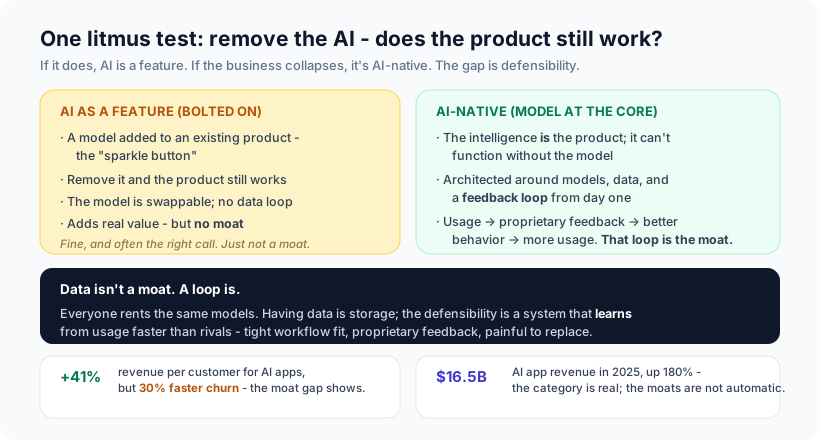
- AI as a feature (bolted on). A model added to a product that already worked without it - the "sparkle button" on the toolbar. Remove it and the product still functions in recognizable form. The model is swappable, there's no data loop, and it adds genuine value but confers no defensibility. This is fine. Most products should add AI features, and doing it well is real work.
- AI-native (model at the core). The intelligence is the product; it cannot function without the model. It's architected from day one around models, data pipelines, and feedback loops - the non-determinism isn't an add-on to manage, it's the substance of the thing.
The mistake isn't picking one. It's cosplaying the other - a bolt-on feature marketed as an AI-native revolution, or an AI-native product built like a traditional app with a model stapled on the side.
The mechanism: data isn't a moat, a loop is
Here's the part founders get wrong, and it's the whole game. "We have a data moat" is the most over-claimed defensibility in AI, because having data is storage, not a moat. The moat exists only if the data feeds back into better product behavior.
The strongest early moat is almost never "better AI." It's a tighter outcome, better distribution, and a system that learns from usage faster than competitors can copy. Everyone can call the same model. Not everyone has a loop that compounds.
A real AI moat is a loop: the product fits a specific workflow, that usage generates proprietary feedback, the feedback makes the product measurably better, and the improvement drives more usage - which generates more feedback. Each turn makes the product harder to replace. Notice this is orthogonal to native-vs-feature: an "AI feature" with a compounding loop can be more defensible than an "AI-native" product without one. The badge is marketing; the loop is the moat.
Which should you build?
The honest answer is usually "a great AI feature," and that's not a consolation prize. If your product delivers real value without the model, adding AI to make it faster, smarter, or more delightful is a strong, achievable move - and trying to force it into "AI-native" often just adds fragility and cost. Reserve AI-native for when the intelligence genuinely is the value: the product only exists because the model does.
Whichever you build, the questions that decide whether it lasts are the same:
- Where is the loop? What proprietary feedback does usage generate, and does it actually improve the product?
- What's the outcome, not the feature? Users pay for a tighter result, not for "it has AI."
- Is it built to be measured? Non-deterministic products live or die on evals and feedback - that's how the loop stays honest.
- Is it safe to give the model real power? If it acts on tools and data, prompt injection and least-privilege design aren't optional.
Our opinion
Our take: stop asking "are we AI-native?" and start asking "where's our loop?" The native-vs-feature debate has become a status game - founders reach for "AI-native" because it sounds defensible, when defensibility actually lives in the compounding feedback loop, the workflow lock-in, and the distribution. A modest AI feature attached to a real loop beats a grand AI-native pitch attached to nothing. And the churn data backs this up: without a loop, an AI product is a novelty with a countdown timer.
We'd also gently deflate the pressure to be AI-native. Most of the best AI products people use every day are, architecturally, excellent AI features on top of a product that already earned its place. Building one of those well - useful, private, measured, safe - is a better goal than chasing a label. This is the same evidence-over-hype instinct behind right-sizing the model to the job: build the thing the problem needs, not the thing the pitch deck wants.
How Ashvara helps
We build both - AI features done right (evals, guardrails, a model that earns its place) and genuinely AI-native products architected around the model and the feedback loop from day one. Either way we start from the questions that decide defensibility: where the loop is, what outcome it compounds toward, and how you'll measure and secure it. You get an AI product that's defensible because it learns, not just because it ships.
If you're deciding how AI fits your product - a sharp feature or a native rebuild - that's exactly the AI solutions work we do. Talk to us and we'll help you build the version with a moat.
Sources: Business of Apps - AI app market ($16.5B in 2025, +180%; downloads +178%); CRV - What Is AI-Native? The Founder's Guide (2026) (the litmus test and the data-loop moat); 2026 subscription benchmarks (AI apps: ~41% more revenue per customer, ~30% faster churn).