Designing a backend an AI agent can actually use
Agents retry, chain, and act unsupervised - so APIs built for humans break. Idempotency, structured errors, and observability make a backend agent-ready.
5 min read
When the thing calling your API is an AI agent instead of a person, the assumptions your backend was built on quietly break - and the fix is the same set of disciplines that make any system fault-tolerant: idempotency, structured errors, a machine-readable contract, and end-to-end observability. A human clicks once, reads an error, and gives up gracefully. An agent retries on a timeout, chains dozens of calls without supervision, and takes whatever your API literally returns at face value. An API that's merely "good enough for the app" becomes a source of duplicate charges, silent failures, and unrecoverable loops the moment an agent drives it. Making a backend agent-ready isn't exotic; it's rigor you can no longer skip.
Why this matters now
Agents stopped being a demo and became a real API consumer this year. Gartner projects that 40% of enterprise applications will embed task-specific AI agents by the end of 2026, up from under 5% in 2025, and reports a net average productivity gain of 19.3% where they're deployed (Gartner). Those agents don't click buttons - they call your APIs, often autonomously and in long chains. So "who calls this endpoint" increasingly includes software that behaves nothing like a browser.
The gap is concrete. A human-facing API leans on a UI to guide the happy path, a person to interpret a vague error, and one supervised request at a time. Strip those away and the same API is fragile: a retried "create" makes two records, a bare 500 leaves the agent with no idea what to do next, and a chain of calls fails halfway with no trace of what happened.
The mechanism: agents are literal, and they retry
Here's why the consumer changes the requirements.
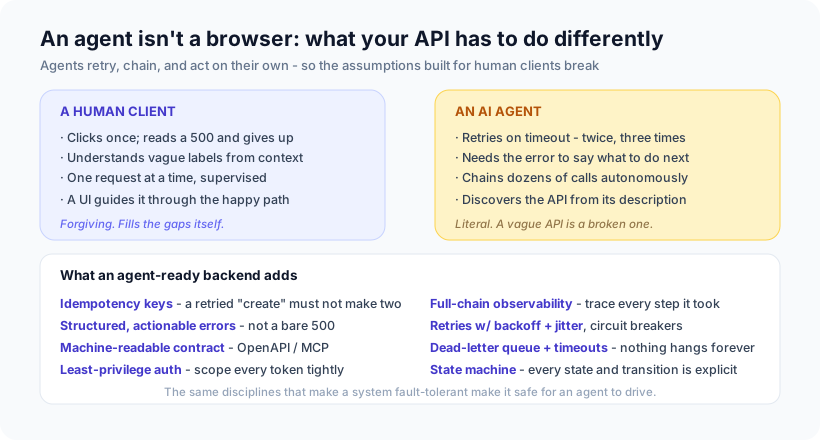
Two properties of agents drive everything:
- They retry. On a timeout or an ambiguous response, an agent tries again - which turns any non-idempotent write into a bug. An idempotency key (a deterministic id derived from the request) lets the server recognize and dedupe the repeat, so "create order" called three times still creates one order.
- They chain, unsupervised. A single agent task can be dozens of tool calls deep. If step 14 fails with an opaque error, the agent can't recover unless the error tells it what went wrong and what to do - a structured, actionable payload, not a stack trace or a bare status code.
A human treats a vague API as annoying. An agent treats a vague API as broken - because it has no context, no intuition, and no patience, only your response to reason from.
What "agent-ready" actually means
The good news: none of this is new invention. It's the fault-tolerance playbook, applied deliberately:
- Idempotency keys on all create-like operations, so retries are safe.
- Structured, actionable errors - a machine-readable reason and a next step, never a bare
500. - A machine-readable contract - OpenAPI, and increasingly an MCP server so an agent can discover your API's capabilities and constraints instead of guessing.
- Least-privilege auth - scope every token tightly, because an autonomous caller will exercise every permission you give it.
- Full-chain observability - trace the entire execution so you can see every step an agent took when something goes wrong.
- Resilience primitives - retries with exponential backoff and jitter, circuit breakers, dead-letter queues, and workflow-level timeouts so nothing hangs forever.
- Explicit state machines for multi-step work, so every state and transition is defined and failure recovery is unambiguous.
Our opinion
Our view: building for agents is mostly a forcing function to do the API hygiene you should have done anyway. Idempotency, honest errors, tight scopes, and real observability make an API better for every client - the agent just fails loudly and expensively when they're missing, where a human quietly worked around the gaps. If your API isn't safe for an agent to retry, that's not really an "agent problem"; it's a latent reliability problem you hadn't been forced to confront.
The one genuinely new muscle is the contract as a first-class product: an agent discovers and reasons about your API from its description, so a precise, machine-readable spec (OpenAPI, MCP) stops being documentation and becomes the interface itself. Vague naming and implicit behavior, which a human absorbs from context, are now defects. This is the same reliability-first instinct behind designing an API that lasts - agents just raise the stakes on getting it right.
How Ashvara helps
We build backends and APIs, and making them agent-ready is exactly our lane: idempotent writes, structured errors an agent can act on, tightly-scoped auth, tracing across the whole call chain, and an MCP or OpenAPI contract precise enough for software to drive safely. You get a backend that's ready for AI consumers - and more reliable for your human ones in the bargain.
If you're exposing your product to AI agents, or want your API built so it's safe for one to drive, that's our backend and API development work. Talk to us and we'll make your backend something an agent can use without breaking it.
Source: Gartner - 40% of enterprise apps will feature task-specific AI agents by 2026; API-design-for-agents best practices (idempotency keys, structured errors, OpenAPI/MCP, observability).